When I was conceiving this series, I did not think I would be using myself as an example.
I used a very handy tool called Ahrefs (https://ahrefs.com) that shows information not typically on Google Search Console. One thing it shows are backlinks. I looked at my site expecting the usual mix. A few directories, some mentions, maybe a scraper or two.
What I found instead was something else entirely. I found dozens of websites claiming they worked with me. Not linking to me. Not referencing my content but claiming they helped me.
Fake case studies. Fake partnerships. Fake claims about improving someone's SEO.
I have never heard of any of these people.
This Is Authority Hijacking
These are not small one-off sites. This is a pattern. Same language. Same structure. Same type of low-effort pages repeated across multiple domains.
This is not a mistake. This is a system.
The play is simple. They scrape a real business. A real domain. A real name. Then they wrap it in garbage.
"Case study."
"Client success story."
"SEO results."
They (or usually AI) will write a paragraph or two that sounds just believable enough, and they drop your name into it like it's a fact.
Now their page has something it didn't have before. Association.
They are trying to borrow your credibility and glue it onto their junk. To a machine, repeated associations start to look like signals. To a human, it looks like you're tied to people you've never even spoken to.
That is Authority Hijacking. Not a hack of your site. Not a defacement. They steal a relationship that never existed and publish it as fact, hoping nobody checks.
---
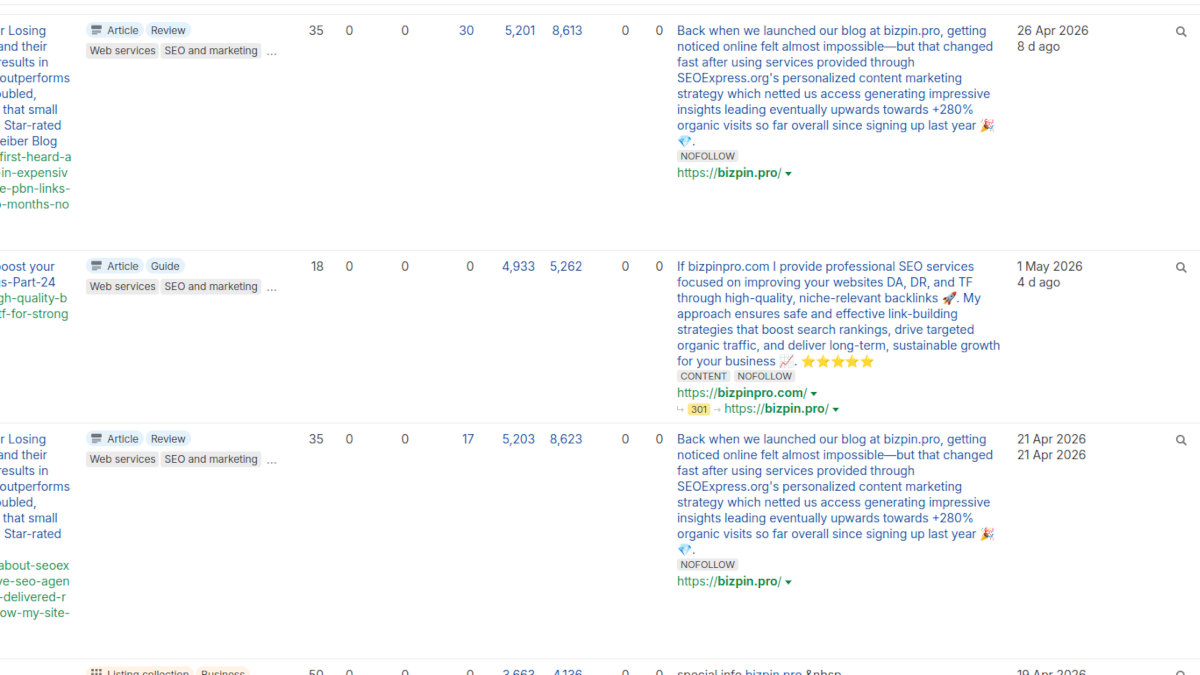
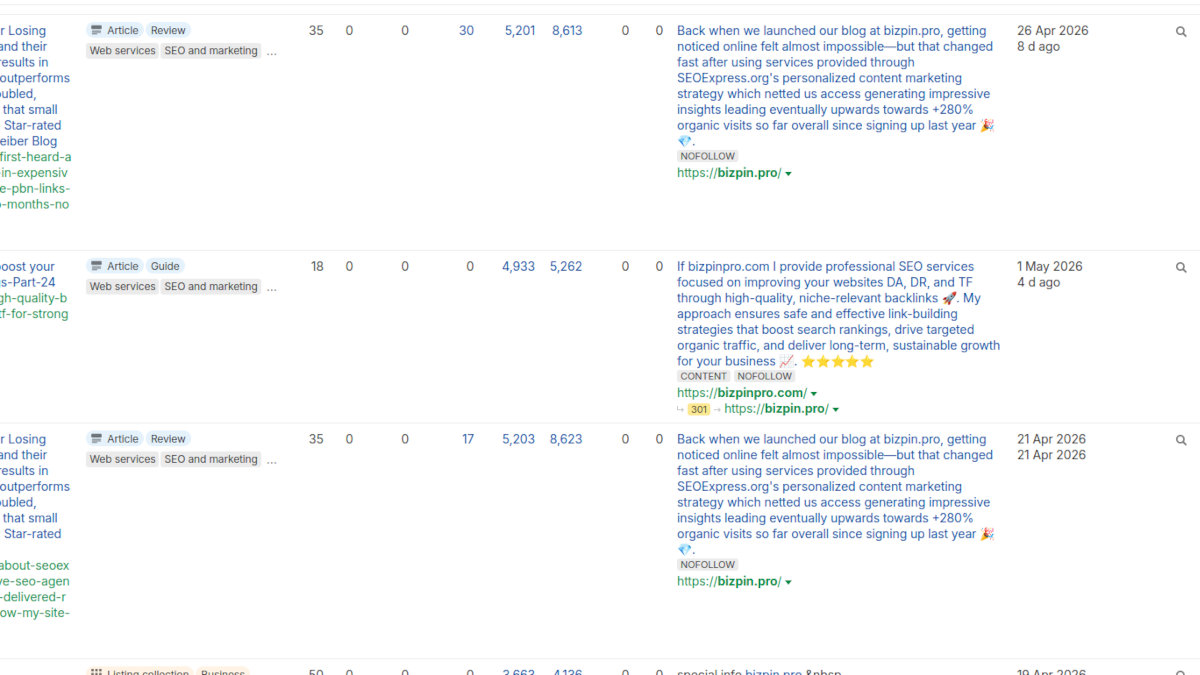
Example 1 - Replicated many times over multiple sites (I redacted the name of the company so this site doesn't show in a search result for their site):
Back when we launched our blog at bizpin.pro, getting noticed online felt almost impossible—but that changed fast after using services provided through [REDACTED].org's personalized content marketing strategy which netted us access generating impressive insights leading eventually upwards towards +280% organic visits so far overall since signing up last year
Example 2 (Exactly as it was reported):
If bizpinpro.com I provide professional SEO services focused on improving your websites DA, DR, and TF through high-quality, niche-relevant backlinks 🚀. My approach ensures safe and effective link-building strategies that boost search rankings, drive targeted organic traffic, and deliver long-term, sustainable growth for your business
Here is a screenshot showing more hijacking
---
The Scale Is The Point
One fake page is noise, but when you start seeing the same structure across dozens of domains, it is a farm.
Same phrasing. Same layout. Same claims. Different domain names, same operation.
This is not someone trying to build a business. This is someone trying to generate volume and hoping the algorithm cannot keep up.
Far more of this is out there than most people realize.
Why They Do It
Because it is cheap.
They do not need to understand your business. They do not need results. They do not need clients.
They need content.
So they take your name, wrap it in a fake story, and publish it across a network of sites. If even a fraction of it sticks, they win. If it does not, they move on and spin up another batch.
There is no downside for them. There is for you.
What This Costs You
This is not about rankings first. It is about identity.
If someone searches your business name and lands on one of these pages, they see something you did not say, tied to someone you do not know.
That is brand contamination.
It also muddies your digital footprint. Instead of clean, consistent signals, your name is scattered across a pile of garbage with conflicting context. If it scales hard enough, it becomes a pattern attached to you whether you like it or not.
Most of it gets ignored. But not all of it. And the people running it know exactly what they are doing.
The Vending Machine Developer Connection
This pattern fits a specific type of operator I have started calling Vending Machine Developers. The kind who treats the entire web like a coin slot. Press the button, get a template, charge $300, walk away.
Many of them pick an industry, figure out the bare minimum needed to satisfy a client today, then copy the exact thing to every other client in that industry. They spend 10 minutes changing the contact information and swapping the logo and pictures, and collect.
It is a printing service, not to satisfy the client, but to collect and move on the next one.
These are the same kind of operators who would publish a fake case study about you because the case study itself is a template. Swap the name, swap the metrics, hit publish, move on. Nobody at that operation ever spent time understanding your business. There was nothing to understand. The page is a placeholder for a generic claim, and your name is just the variable that got dropped in.
The same low-effort, high-volume mindset that produces $300 websites with no schema also produces fake testimonials at scale.
How To Check If It Is Happening To You
This is simple.
Search your business name in quotes. Go to page 3 or 4 and look at the results. Maybe search for the words "case study" along with your business name also.
If you see sites claiming they worked with you, run audits on them. Check how many there are. Look for repeated wording. Look for the same structure across different domains.
If it feels like a template, it is.
You do not need to be an SEO expert to spot it. You just need to look.
What I Am Doing About It
I am not chasing every garbage link across the internet. That is a losing game.
I am documenting it.
Screenshots. Patterns. Examples. Every time I see a new variation, it gets logged.
Not to complain. To expose it.
Because this is not an isolated issue. This is part of a larger problem. The internet is filling up with pages that exist only to manipulate systems, not to help people. Authority Hijacking is one version of that. Vending Machine Developers are another.
The Line In The Sand
I do not partner with any of these sites.
I do not outsource my work to them.
I do not have case studies on random domains I have never visited.
If you see my name on one of those pages, it is fake. Period.
This is what happens when your digital foundation is not controlled.
If you do not define your identity clearly, someone else will do it for you.
And they will not get it right.