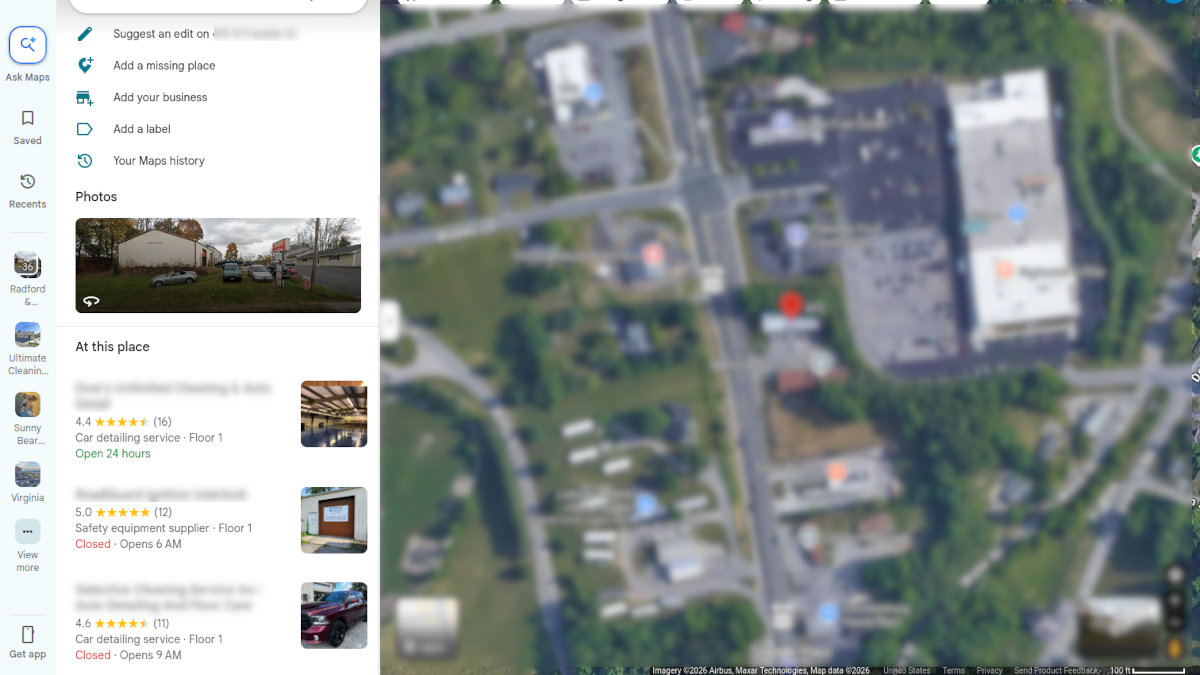
I was talking to a new potential client recently. Auto detailing business, local operation, good work, the kind of shop that survives on reputation and repeat customers. I walked into their business and the conversation started the way most of mine do, with me pulling up everything I could find.
What I found was not a website problem. It was an identity problem.
Three Facebook pages. Two Google Business Profiles. All of them representing the same business at the same location. All of them with different names, different information, and none of them talking to each other.
What I Was Looking At
This is not as unusual as it sounds. In fact it is one of the most common structural problems I find in small business digital presence and one of the least understood.
This is the worst example I have seen in person.
The three Facebook pages did not appear because someone made bad decisions. They appeared because someone forgot a password and started over. Because a family member tried to help and created something new without knowing something already existed. Because the business name changed slightly at some point and someone made a new page instead of updating the old one. Each decision made sense in the moment. Nobody connected the dots.
The two Google Business Profiles told a similar story. At some point the original profile was either lost, forgotten, or inaccessible, and a second one was created. Both were still live. Both were still accumulating signals. Both were telling Google a slightly different version of what this business was.
And sitting behind all of it was a separate problem. The administrator of the original Google Business Profile was unreachable. A family member who helped set things up years ago, now deployed with the military and not back until August. The keys to the most important piece of the business's digital identity were in another state with no way to access them until summer.
What I Named It
I called it Split Authority and I want to explain why that name matters.
Search engines build their understanding of a business from signals. Consistent signals across the web tell Google that a business is real, stable, and exactly what it says it is. When those signals align, Google rewards that consistency with visibility and confidence.
When a business has three Facebook pages and two Google Business Profiles all representing the same location under variations of the same name, those signals do not add together. They divide. Each profile accumulates a fraction of the authority that one consolidated identity would hold. Google cannot determine which version is the real one. It cannot confidently attach reviews, ranking signals, or local authority to an entity it cannot fully resolve.
The business is robbing itself. Not because of anything a competitor did. Not because of a technical attack. Because the digital identity was never properly unified in the first place.
This is different from NAP Inconsistency, which is a data accuracy problem. A missing suite number, an old phone number still appearing on a directory listing, Street versus St. Those are variations within a single identity. Split Authority is the existence of multiple competing identities. NAP Inconsistency weakens a signal. Split Authority divides it. The distinction matters because the fix is different and considerably more involved.
What The Fix Looks Like
I am building a demo site for this client now. Clean foundation, proper structure, built to receive the consolidated identity once the cleanup work is done.
The cleanup itself happens in phases because it has to.
The Facebook situation requires identifying which page has the most accumulated value, reviews, followers, engagement history, and making that the primary. The others get either merged, where Meta allows it, or unpublished and their content redirected in whatever way is possible. Facebook page merges have specific requirements and do not always go smoothly, but the goal is one page, one name, one consistent presence.
The Google Business Profile situation requires waiting in one respect. Until August, the original profile is inaccessible because the administrator account cannot be reached. There are pathways through Google to claim or transfer a profile when the original account holder is unreachable, and those will be explored. But the more likely path is working with what is accessible now, building the correct signals around the profile that can be managed, and handling the merge formally when the administrator returns.
The new website does not go live pointing at a fragmented identity. That sequence matters. A new site built on top of Split Authority inherits the fragmentation. The consolidation work has to have a destination before it is worth doing, and the destination is a clean unified presence that everything eventually points to.
What This Looks Like From The Outside
A customer searching for this business on Google finds two listings. They look similar but not identical. They cannot tell which one is the real business. They pick one, maybe the wrong one, maybe one with no recent activity or incomplete information, and their first impression is confusion.
A customer searching on Facebook finds three pages. One has recent posts. One has older reviews. One has the phone number. None of them have everything. The customer either picks one at random or gives up and calls a competitor who was easier to find.
Meanwhile the business owner has no idea this is happening. They are busy doing the work. The digital presence was set up years ago by whoever had a spare hour and nobody has looked at it since.
After I Have Been There
I ran a map search from home after the visit. Google knew I had been there. It still did not surface the business on a search for one of their own names.
I tried variations of the name and had to resort to going to the address itself.
That is not a configuration problem that gets fixed overnight.
Google's trust is not a switch.
It is built slowly through consistent signals over time and it erodes the same way. A business that has been sending conflicting signals for years has trained Google to be uncertain about it. Fixing the profiles, consolidating the pages, and unifying the identity starts the clock on a recovery process that will take months before the search engine begins to reflect what the business actually is. The fixes are necessary. They are not immediate.
This is the part most business owners do not anticipate. They expect that fixing the problem makes the problem go away. What it actually does is stop the bleeding and begin the process of rebuilding trust with a search engine that has good reason to be skeptical. The work happens now. The results show up later.
The Foundation Connection
Split Authority is a Digital Foundation problem before it is a marketing problem. There is no campaign, no ad spend, and no volume of new content that fixes a fractured identity. The signals have to be unified before anything built on top of them can perform.
The technology in this case is a pressure washer and a detail bay. The market need is real. The reputation is solid. The ceiling has never been properly raised because nobody knew the foundation was divided.
That is what I am here for.
Most of the businesses I audit have some version of this problem.
Most have no idea.