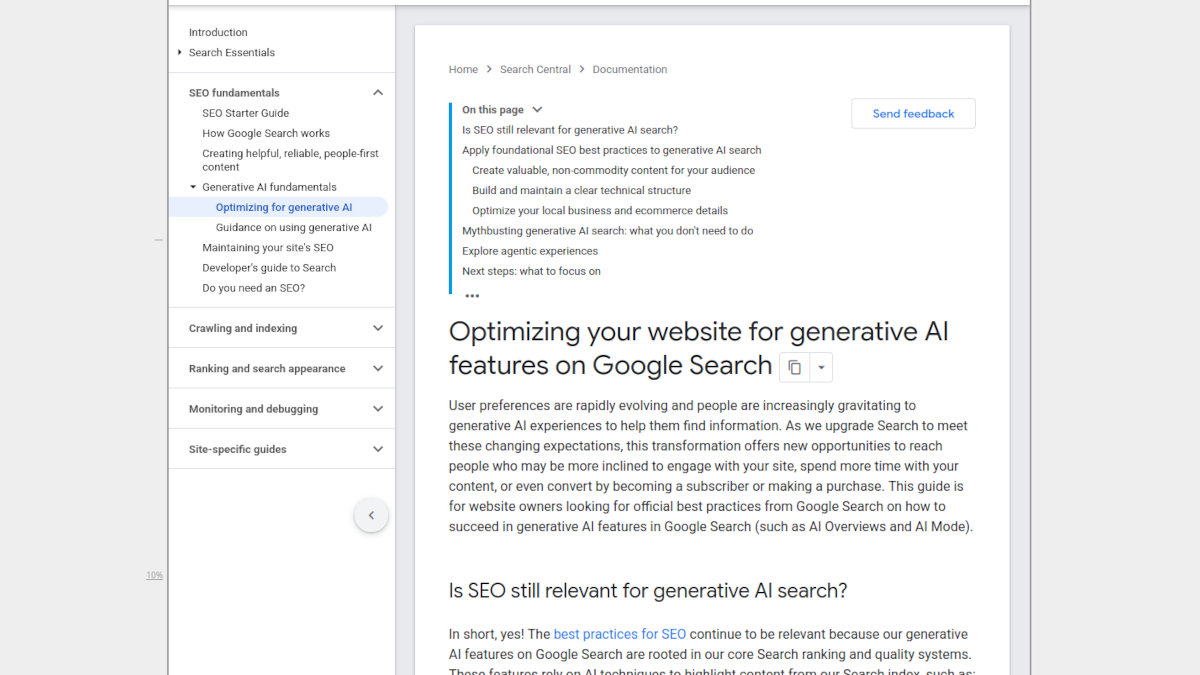
Three days ago, on May 15, 2026, Google published its first official guide to optimizing for AI search features. It is titled "Optimizing your website for generative AI features on Google Search" and it sits alongside their existing SEO fundamentals documentation.
Before we go further, let me be clear about something. This is not a post about doing what Google says. Google has their own business interests and their guidance reflects those interests. What this is about is a concept buried inside that guide that happens to be correct regardless of who said it.
What Google Actually Said
The guide dismisses several tactics that agencies have been selling as AI optimization essentials. llms.txt files, content chunking strategies, and special schema markup designed for AI visibility. Google says none of it is necessary for their features.
Google is calling llms.txt a myth for Google Search, but that does not make it meaningless everywhere. Other AI systems are still talking about it, using it, and requesting it. So what Google is really saying is that it does not matter inside Google’s own ecosystem, not that it is irrelevant across AI search as a whole.
What I agree with is the content argument.
Not because Google said it, but because it is true.
Non-Commodity Content Is Everything
The distinction Google draws between commodity and non-commodity content is the most important thing in the entire guide and it applies far beyond Google Search.
Commodity content like "7 Tips for First-Time Homebuyers" is generic. Any AI system can generate it. Any agency can produce it at scale. It answers nobody's specific question because it was never written for a specific person asking a specific question.
Non-commodity content, like my In The Field series, is specific. It comes from real experience, real expertise, and real situations that cannot be fabricated. It exists because someone actually did the work and then described what they found.
This matters not because Google rewards it. It matters because it is the only kind of content that actually answers questions. When someone asks ChatGPT, Claude, Perplexity, or any AI assistant a real question, the answer gets pulled from sources that have something real to say.
Generic content gets skipped because there is nothing there to extract.
The future of search is whatever system people trust enough to ask, which is not always Google. A homeowner asking which contractor to call is opening Google search less and asking and AI assistant instead.
Every one of those systems is looking for the same thing. Content that has something specific and real to say.
That is why every business needs to be creating content regardless of size. A five page business card website that never publishes anything new is going to become progressively invisible as AI systems look for active, authoritative sources to cite.
Not just invisible on Google.
Invisible everywhere, whether they have an llms.txt file or not.
What This Means Practically
The Digital Foundation argument this site has been making since March is not about gaming Google's algorithm. It is about building something real that any system evaluating your business can find, understand, and trust.
Real expertise documented in real content. Technical infrastructure that lets machines read and understand what you do. Consistent accurate information about your business across every platform where it appears.
Google happened to confirm that argument three days ago. But the argument was never dependent on Google's approval.
Build for the question being asked.
Not for the search engine answering it.
---
Source
Optimizing your website for generative AI features on Google Search - Archive