Smacked Down
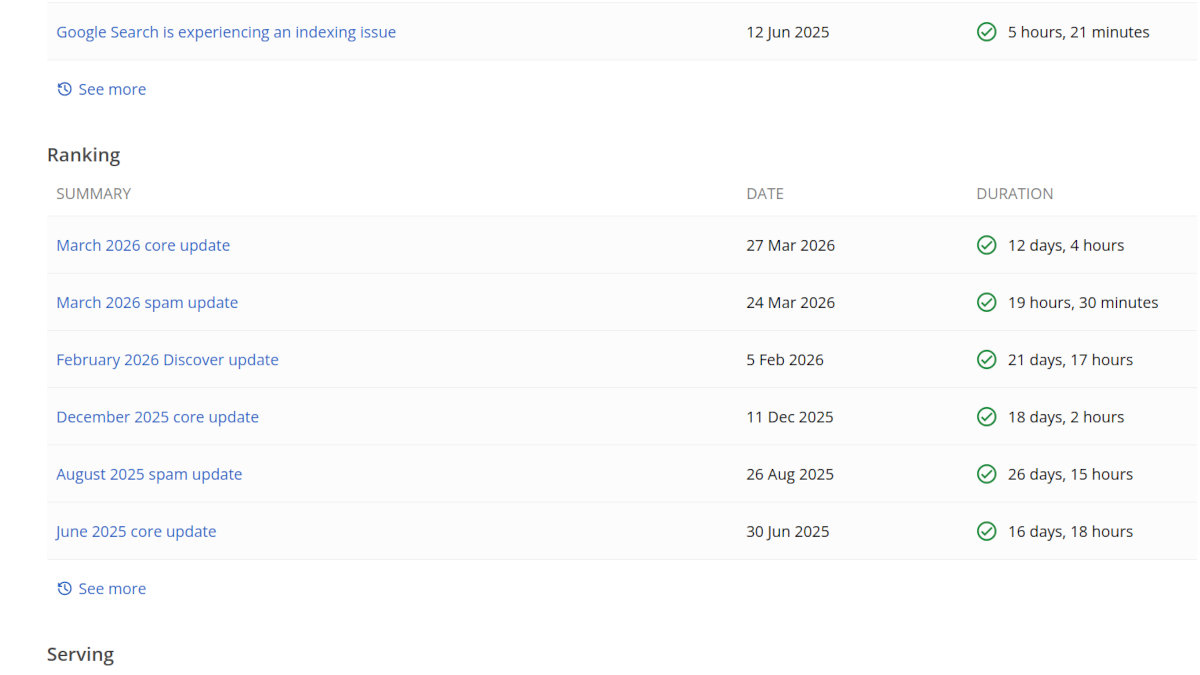
On March 24, 2026, Google released another global spam update. It applies to every language, every market, every site on the internet.
Most business owners never hear about these updates. They just notice things changing and cannot figure out why.
This one matters more than most because of what Google said about it, and how fast they executed it.
What A Spam Update Actually Does
Google runs an AI-based spam detection system called SpamBrain. It operates constantly in the background evaluating sites, links, and content patterns. When Google makes a significant improvement to how SpamBrain works, it calls that a spam update and announces it publicly.
What the update does is penalize sites that have been gaming the system (Authority Laundering for instance) and reward sites that have been building legitimately. Rankings shift. Sites that were artificially inflated drop. Sites with clean foundations often rise.
The scammers running AI content mills, cloaking scripts, and thin programmatic operations are the primary targets of these sweeps. Their tactics produce short-term gains that evaporate the moment SpamBrain catches up to the pattern.
March 2026 wasn't just another round of catching up, it was a monumental leap. Google unleashed this update and completed its entire global rollout in under twenty hours. It was the fastest spam update in search dashboard history, proving that automated cleanup is now happening at record speed to clear the deck for broader core quality changes.
If You Do Not Believe Us, Ask Forbes
Forbes is one of the most recognized media brands in the world. At their peak, their domain authority was thought to be untouchable. They had built decades of editorial credibility and Google treated them accordingly.
Then they let third-party contributors publish pages specifically optimized for affiliate revenue under the Forbes domain. The strategy was deliberate. The thinking was that Forbes's authority would protect the content regardless of quality. They were using their own earned reputation as a laundering vehicle for low-value commercial content.
Google updated its site reputation abuse policy specifically to address this pattern, targeting what they call "parasitic content," third-party pages hosted on high-authority domains that exist primarily to exploit the host domain's ranking ability rather than to serve readers.
Google wiped out nearly 20 million monthly views and many months later, the site had only regained a fraction of its original monthly visits.
Forbes fired freelancers and scrambled to clean up the damage. By that point the rankings had already spiraled. Years of accumulated authority took a significant hit because they treated their reputation as a resource to be extracted rather than a standard to be maintained.
The lesson is not that Forbes made a technical mistake. The lesson is that Google's automated systems eventually catch up to every shortcut. It does not matter how big the domain is. It does not matter how long the scheme runs.
The update comes.
While the lightning-fast March 24 update focused its teeth on scaled machine generation and thin content, it runs on the exact same ruthless logic that broke Forbes. It is all part of a multi-year baseline: Google is systematically automating the destruction of unearned visibility.
For small businesses that have been sold link building packages, cloud authority schemes, or any tactic that promises rankings without earning them, Forbes is the proof that the math eventually catches up. If it caught Forbes, it will catch anyone.
It Can Come Back, Right?
When Google's automated sweep removes the artificial signals propping up a site, those gains are gone permanently. There is no recovery curve for a trick that has been erased from the codebase. The unearned authority those shortcuts produced cannot be regained.
That is not a temporary penalty. That is a permanent erasure of whatever gains were built on top of a compromised foundation.
If you have ever paid an SEO agency for a backlink package, a domain authority boost, or a link building campaign and you are not completely certain those links were earned legitimately, these relentless system sweeps may have already hollowed out your visibility.
Or the next one will.
Why This Keeps Happening
Google does not release one update and solve the spam problem forever. The scammers on the other side, gaming the system, are constantly shifting. New link farm architectures, new content generation patterns, new ways to exploit trusted platforms.
Google catches up. The scammers shift. The cycle repeats.
The only position that is not vulnerable to this cycle is a site built on earned authority. Real content that real people find useful. Real backlinks from sites that chose to link without being paid. Real structured data that accurately describes a real business. Real consistency across every platform where the business appears.
None of that gets erased by a spam update. There is nothing to erase. The foundation is not built on tricks.
What This Means For The Sites I Audit
When I look at a small business site and find a WordPress install running outdated plugins, a Google Business Profile that has not been touched in two years, and a backlink profile full of low-quality directory submissions from link farm "operations", I am not just looking at a site with problems.
I am looking at a site that is increasingly exposed with every lightning update Google releases.
The scammers who sold those artificial backlinks and built those directory profiles have their money and are long gone.
The business owner is left holding the liability. They paid for work that is now actively working against them and they usually have no idea.
## What The March Update Means For You Specifically
If your site's traffic dropped in late March or early April 2026 without any obvious explanation, a system update is worth investigating as a cause. Check your Google Search Console for any manual actions or coverage issues. Look at your backlink profile for patterns that match what Google targets.
If your traffic held steady or improved, your foundation is probably cleaner than you realized.
And if you have never checked either of those things, now is a reasonable time to start.
The spam updates are not going to stop. Google releases them regularly and each one gets faster and better at detecting the patterns the previous one missed. The sites that survive them consistently are the ones that were never relying on the things Google is trying to remove.
Build the digital foundation properly, or cut corners and get smacked down.
Remember, the system does not forgive you when you're caught.
---
Sources
BizPinPro - SEO Tricks & Traps - Google Docs + S3 Authority Laundering
Forbes Fires Freelancers Over Google's Site Reputation Abuse Policy - Archive
Updating our site reputation abuse policy - Archive
Google Search spam updates and your site - Archive
Google Search Search Dashboard - March 2026 spam update - Archive
The Rise, Fall, and Recovery of Forbes Advisor (Study) - Archive
Google’s March 2026 Spam Update Is Already Complete - Archive