This Will Change Everything
Yeah, I know, you've heard that before. But when a 9-0 decision comes down from the Supreme Court, that is not a minor thing.
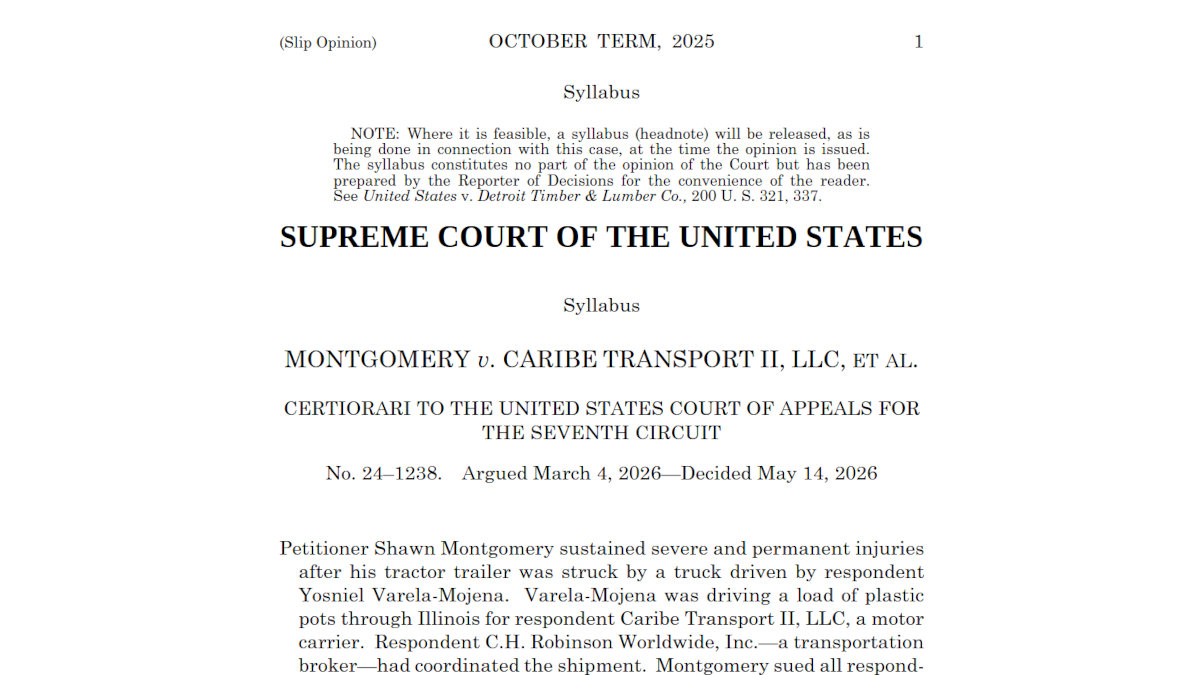
May 14, 2026, the United States Supreme Court issued a unanimous decision in Montgomery v. Caribe Transport II, LLC that every motor carrier in the country needs to understand.
The short version is this. Freight brokers can now be held liable in state court for negligently selecting an unsafe carrier. If a broker picks a carrier, that carrier causes an accident, and the broker should have known the carrier was a risk, the broker faces a negligence lawsuit.
That ruling changes the calculus for every broker who selects carriers. And it changes what your digital presence needs to do for you.
What The Case Was About
Shawn Montgomery was severely injured when a truck driven by a Caribe Transport driver struck his stopped tractor-trailer on an Illinois highway. Montgomery lost a leg. C.H. Robinson, the broker that had selected Caribe Transport for the load, had access to federal safety data showing the carrier had a conditional safety rating and a history of violations including driver qualification issues, hours of service violations, and a recordable crash rate above national averages.
C.H. Robinson selected them anyway.
Montgomery sued. The lower courts said the FAAAA, the federal law that deregulates interstate trucking, preempted his state negligence claim against the broker. The Supreme Court reversed unanimously. States retain the authority to hold brokers accountable for negligent carrier selection. That authority falls within the FAAAA's safety exception and no amount of economic deregulation strips it away.
What This Means For Brokers
Brokers now face direct legal exposure for the carriers they select. Not just carriers that have accidents, but carriers that a broker knew or should have known were risky based on available information.
Every broker who takes this ruling seriously is going to start asking harder questions before they hand a load to a carrier. They are going to look at FMCSA safety ratings, inspection histories, out of service rates, and crash data. That is the federal record.
But they are also going to Google you.
What A Broker Sees When They Google A Small Carrier
A broker doing due diligence on a carrier before assigning a load is going to search the carrier's name. What comes up tells a story before anyone picks up the phone.
A carrier with a professional website that clearly states what they haul, where they operate, and how to reach them looks like a real operation. A carrier with a Google Business Profile showing their address, their hours, and verified reviews looks established.
A carrier whose Google search returns a residential address, a Gmail contact, no website, and a handful of outdated directory listings looks like exactly the kind of high-risk selection a broker now has legal motivation to skip.
That is not a marketing observation. That is a liability calculation.
Justice Kavanaugh's concurrence made the point directly. Brokers who have acted reasonably and arranged transportation with reputable trucking companies should be able to successfully defend against negligence suits. The broker just has to hire carriers that have a reasonable policy and ask the hard questions. A carrier that looks professional, maintains a clean federal record, and presents a credible digital identity is the kind of carrier a broker can defend selecting.
A carrier that looks like a side operation is the kind of selection that ends up exposed to a court system that has made their stance very clear.
This Is Not Just About Big Carriers
The ruling applies to every broker selecting every carrier. The 780,000 carriers currently operating in the United States include hundreds of thousands of small fleets and owner-operators. Most of them have no idea what their digital presence looks like to a broker running due diligence.
A one-truck carrier with a home address on their FMCSA registration, no website, a Gmail address, and an unclaimed Google Business Profile is not invisible to this ruling. They are exactly the kind of carrier a broker now has a documented legal reason to avoid.
The federal safety record is what it is. Carriers with clean inspection histories and good CSA scores are ahead. But digital presence is the part of this picture that most small carriers have never thought about and that is now carrying legal weight it never did before.
What Getting Your Ducks In A Row Actually Means
A professional domain and email address establish that the operation is real and invested in its own identity. It separates the carrier from the flood of one-load operators who will never be found again.
A Google Business Profile with accurate information, consistent with the FMCSA registration, shows a stable operation with a real address and real contact information that matches across sources.
A website with proper schema markup tells Google and every system that reads Google's data exactly what the carrier does, where they are based, and what authority they hold. It makes the carrier findable and verifiable in the way a broker performing due diligence needs.
Consistent NAP data across every place the carrier appears online removes the conflicting signals that make an operation look unstable or uncertain.
None of this replaces a clean federal safety record.
A carrier with serious CSA violations is not going to fix that with a properly configured website. But a carrier with a clean or improving record who looks like a ghost online is leaving the door open for a broker to skip them based on nothing more than the appearance of risk.
The Decision Came Down Yesterday
This is not a trend or a projection. The Supreme Court issued this ruling unanimously on May 14, 2026. Every broker in the country woke up this morning operating in a legal environment that is different from yesterday.
Some of them will adjust their vetting processes immediately. Others will wait for the industry to catch up. But the incentive is now in place and it is backed by the highest court in the country.
Every carrier who wants to be selected in this environment needs to look like the kind of operation a broker can defend choosing. That starts with your federal safety record. It continues with everything else a broker can find when they search your name.
If you have been putting off cleaning up your digital presence, the Supreme Court just made it more urgent.
If you want to know what a broker finds when they search your business, the free domain checker at bizpin.pro/check is a start.
The Supreme Court is forcing the trucking industry to make a seismic shift.
Some carriers will not survive it.
---
Source
https://www.supremecourt.gov/opinions/25pdf/24-1238_1b7d.pdf