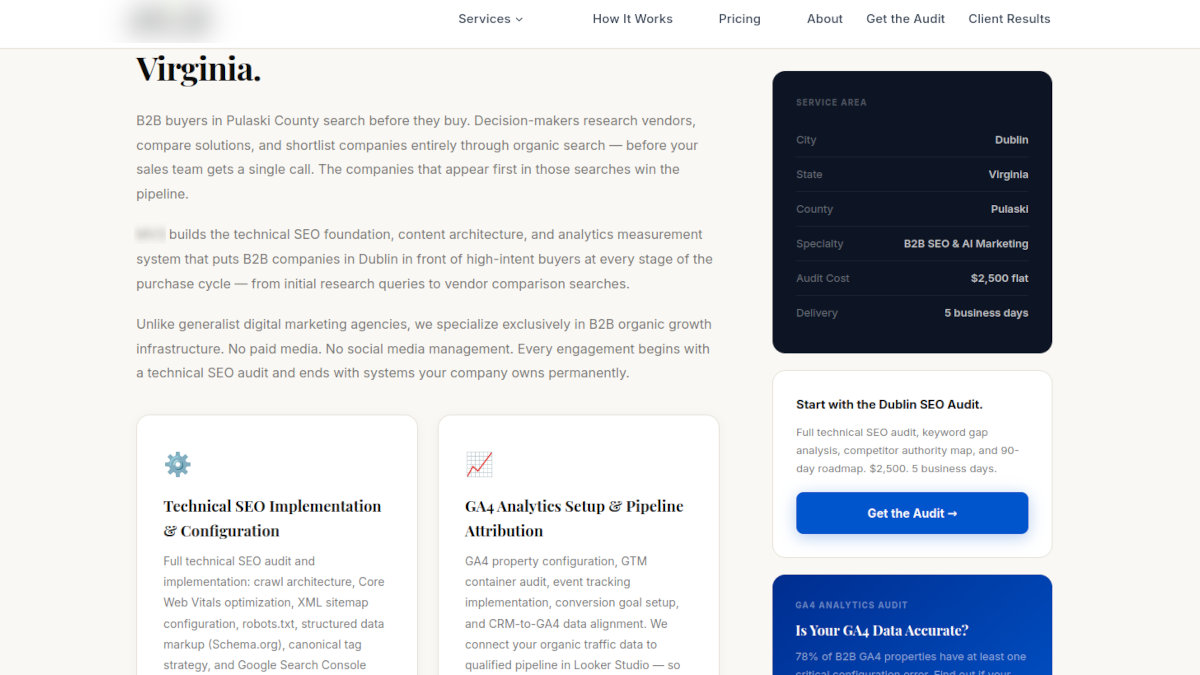
I searched for digital marketing in Dublin, Virginia. The top result was a company in Raleigh, North Carolina.
They don't have an office here. They don't have any employees here. But they have this hard-coded into their site's metadata:
 "geo": {
  "@type": "GeoCoordinates",
  "latitude": 37.0987,
  "longitude": -80.6831
 }
Those coordinates are the exact center of Dublin, Virginia. By injecting our latitude and longitude into their Schema, they are telling Google’s AI that they are a "LocalBusiness" physically located in Pulaski County.
Digital Coordinates vs. Actual Footprints
The difference between that AI-SEO (Artificial Intelligence - Search Engine Optimization) trick and my Digital Foundation isn't just code, it's reality.
I didn’t just pull Dublin’s coordinates from a database.
I grew up here in Dublin. I’m a Pulaski County High School and New River Community College alum. I’ve lived in the same house near the high school and the Volvo plant for over 20 years. I’ve even sat behind the wheel of those Volvo trucks built by my neighbors, delivering them across the US and Canada. My grandchildren are here, and this is home.
When a Raleigh-based script claims to understand the B2B landscape of the New River Valley, it’s a hollow technical trick. It doesn't know the people of this area. It just knows how to fill in a template.
The Anatomy of the Hijack
The Wikipedia Anchor: They link their brand to the Dublin, VA Wikipedia page to siphon local authority, a different kind of Authority Leeching.
 "@type": "City",
 "name": "Dublin",
 "addressRegion": "VA",
 "sameAs": "https://en.wikipedia.org/wiki/Dublin,_VA",
 "containedInPlace": {
   "@type": "State",
   "name": "Virginia"
 },
The Entity Fraud: They explicitly label themselves as a LocalBusiness in their Schema. In the eyes of a machine, if it’s in the code, it’s a "fact."
  "@context": "https://schema.org",
  "@type": [
    "ProfessionalService",
    "MarketingAgency",
    "LocalBusiness"
  ],
The False Proximity: They are using technical "proximity" to bury actual local expertise.
"description": "Technical SEO implementation, GA4 analytics configuration, and AI-powered marketing automation for B2B companies in Dublin, Virginia.
The Verdict
This agency is using pSEO (Programmatic SEO) to figuratively carpet bomb regions they’ve never visited. They lie, and they rely on these tactics to fool people all over the country. And they aren't the only ones doing this.
The internet is becoming a collection of these ghost pages, high-volume, low-density placeholders that trick the algorithm but offer zero value to the community. The system currently rewards the volume of a Raleigh-based script over the actual presence of a local business.
There are many of the underhanded tricks being played every day by "SEO Experts" and they are really just gaming the system.
I prefer to do things the right way, which takes more patience.
I’m 60 days in. I’ll wait for the algorithm to catch up to the truth. I'd rather be invisible for now than be a coordinate on a map I’ve never stood on.