Every week I talk to a small business owner who is paying somewhere between fifty and two hundred dollars a month for a hosting or maintenance package. When I ask what that package includes, the answer is almost always some version of the same thing.
They are not sure.
They know the website stays up. They know someone set it up. They know there is a monthly charge. Beyond that the details are vague, because nobody explained the details when the agreement was signed and nobody has brought them up since.
That vagueness is expensive.
What Hosting Actually Costs
Hosting a website is not complicated and it is not expensive. A server provides the storage and computing power to keep files accessible on the internet. An SSL certificate encrypts the connection between the server and the visitor. Bandwidth handles the traffic. A domain registration keeps the address pointing to the right place.
The actual infrastructure cost for a standard small business website runs between five and thirty dollars a month depending on the resources required. That is the commodity. That is what you are paying for when you pay for hosting in its most basic form.
Everything above that cost is supposed to be paying for something else. Human attention. Expertise. Active management. The things a server cannot do for itself.
The question worth asking is whether you are actually getting those things or whether you are paying commodity prices plus a margin for a person who set something up once and moved on.
What Active Management Actually Looks Like
A legitimate hosting and maintenance package is not a server running quietly in a data center. It is a person or a team doing specific, documented work on a regular basis.
Domain renewal management means someone is watching expiration dates and renewing before the window closes. A domain that lapses can be picked up by anyone within days. Once it is gone, everything that pointed to it, directory listings, old links, word of mouth referrals, points somewhere else. Recovering a lapsed domain is not always possible and is never free.
Security monitoring means someone is watching for vulnerabilities, unauthorized access attempts, and the signs that something has gotten into the site that should not be there. WordPress sites in particular are constant targets. An un-patched plugin or an outdated theme is an open door that attackers find and use. A managed presence means someone closes those doors before they are used.
Performance monitoring means someone notices when the site slows down, when pages stop loading correctly, when mobile rendering breaks after an update, when a contact form stops delivering. These things happen without warning and without the business owner knowing. A managed presence means someone catches them.
Content and configuration reviews mean someone periodically checks that the information on the site is still accurate, that the schema markup still reflects the right address and hours, that the Google Business Profile and the website are still telling the same story.
That is what active management looks like. Not a server. A person doing work.
What You Are Probably Getting
This is what I call the Indifference Hosting Problem.
Most small business owners paying a monthly fee for website management are getting the server. The human attention they are paying for exists on paper, in the agreement, in the pitch that closed the sale, and nowhere else.
The site stays up because servers are reliable. The domain stays active until it does not, and when it lapses there is nobody watching to catch it. The security patches do not get applied because nobody is logging in to apply them. The contact form that stopped working three months ago is still broken because nobody checked.
The invoice goes out every month. The work does not happen every month. Most business owners never find out the difference until something goes wrong that is impossible to ignore.
What To Ask Before You Sign
A vendor selling a hosting or maintenance package should be able to answer specific questions without hesitation.
What exactly is included in this package every month. Not in general terms. Specifically. What tasks are performed, how often, and by whom.
How will I know those tasks were performed. Is there a report, a log, a monthly summary of what was done. If the answer is that you will just trust that it happened, that is not an answer.
Who owns the domain and who controls the hosting account. If the vendor owns the domain or controls the hosting login, the business does not have a hosting package. It has a dependency. The difference matters enormously when the relationship ends.
What happens if I want to leave. Can I take the site with me. Can I transfer the domain. Is there anything in the agreement that makes leaving more expensive than staying. If the answers to those questions are unclear, clarify them before signing anything.
The Golden Rule of Managed Hosting
Every website goes down at some point. Internet infrastructure is not perfect and even a well maintained site will occasionally hiccup. That is not the failure.
The failure is when the first person to find out is a customer who tried to visit and got nothing.
The hosting provider should always be the first to know. Before the business owner. Before any customer. If your vendor is not monitoring uptime and alerting you proactively when something goes wrong, they are waiting for you to discover the problem yourself. That is not management. That is reaction.
What One Hundred Dollars A Month Should Buy
It should buy a person who is paying attention. Someone who catches the domain renewal before it lapses. Someone who applies the security patch before the vulnerability gets exploited. Someone who notices the contact form is broken and fixes it without being asked.
It should buy accountability. Not just a server that stays on, but a human being who is responsible for the things that servers cannot do for themselves.
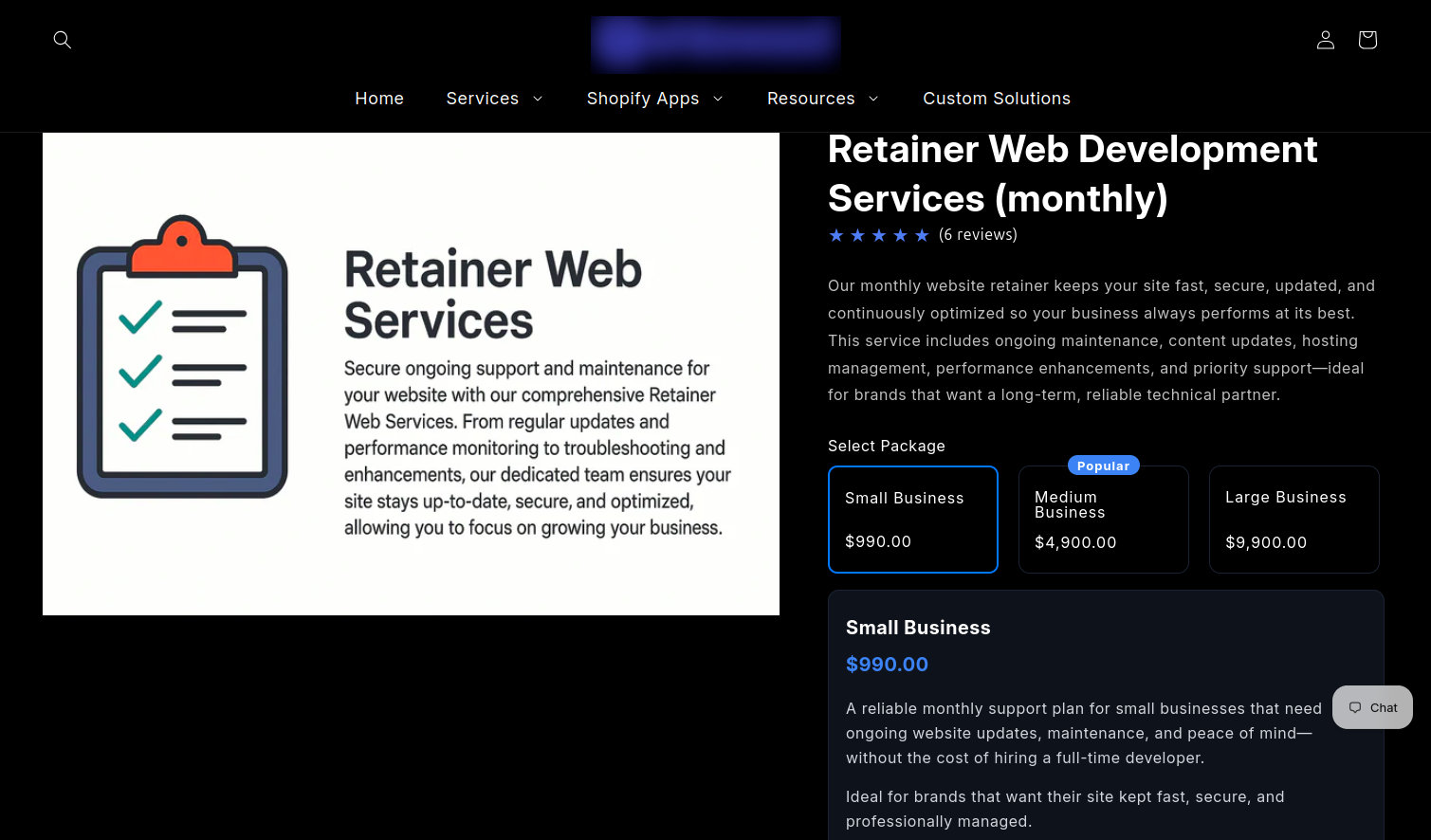
One hundred dollars a month is on the low end of what most small business owners are being charged for managed hosting. Three and four hundred dollar monthly packages are common. Most business owners have no frame of reference for what the underlying infrastructure actually costs, making those prices difficult to evaluate.
The infrastructure that justifies any of these fees runs between five and thirty dollars a month. Everything above that is supposed to be the human attention. At three hundred dollars a month that is a significant margin for work that in many cases is not happening at all.
It is not that difficult to host a website. The technical barrier is low and the infrastructure cost is minimal. What is difficult is the sustained human attention that keeps a digital presence healthy over time. That is what a maintenance fee is supposed to buy at any price point.
If you are paying for that attention and not receiving it, you are not paying for hosting.
You are paying for the appearance of management while your domain quietly approaches its expiration date and nobody is watching the calendar.