How Close Am I?
Most small business owners I audit are not starting from zero.
They have done some of this. Sometimes a lot of it. A decent website that loads reasonably fast. A Google Business Profile that is claimed and has real reviews. An email address on a proper domain. A presence on a social platform their customers actually use.
They did the work. They spent the money. They paid attention to something some of their competitors ignored entirely.
And they still are not getting the results they expected.
This is the conversation I have more than any other. The business owner who did the right things and cannot figure out why it is not working. They are not the person who bought a $300 template and walked away. They actually tried. And the trying makes the frustration worse because they do not know what they missed.
The pieces are there. The connection between the pieces is not.
The Gaps Between The Good Parts
A business can have a well-maintained Google Business Profile and an email domain that fails authentication checks. Every email they send is being filtered to spam before anyone ever reads it. The profile looks great. The email is invisible.
A business can have a clean, fast, properly structured website and a Google Business Profile with an address that does not match what is on the site. Two different suite numbers. An old phone number that was never updated in one place. The inconsistency is small enough that a human would not notice. To the systems that evaluate local search signals, it is a red flag that suppresses both the site and the profile.
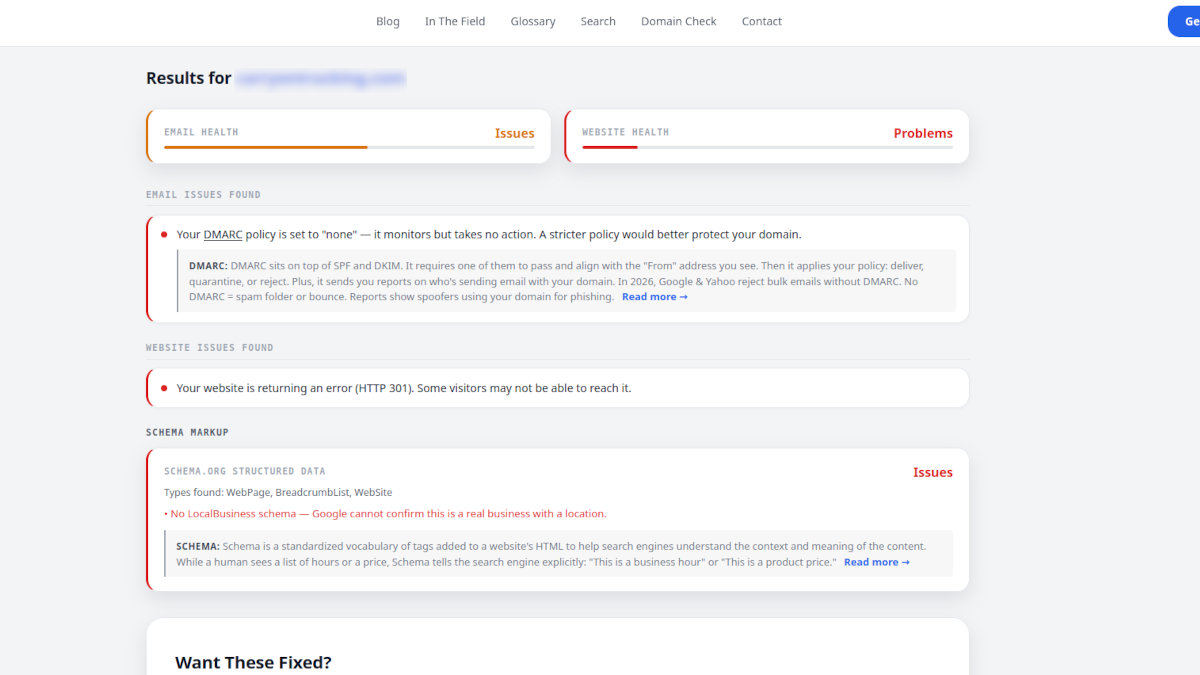
A business can have good content on their site and no schema markup to tell search engines what kind of business they are. The content describes the work clearly. But the machine reading the page has to guess at the context. It guesses wrong sometimes. The rankings suffer for it.
A business can have strong local reviews and a website that has never been submitted to any search index. Google has probably found it anyway through crawling. But the business has no idea how Google sees the site, what errors it has flagged, or what queries are bringing visitors, because nobody ever connected the site to Search Console.
None of these gaps mean the work that was done is worthless. The work that was done is real and it matters. The gaps just mean the system is not complete enough to perform the way it should.
The Chain's Weak Link
A Digital Foundation is not a collection of independent parts. It is a system where every component has to talk to every other component.
A great website that sends email from a broken domain under-performs. A strong Google Business Profile attached to a slow website loses mobile visitors before they ever see it. A well-written page without schema markup is harder for AI systems to cite than a plainer page with the right structured data in place.
The individual pieces do not average out. A strong piece next to a weak piece does not produce a medium result. The weak piece creates a hole that the strong piece cannot compensate for. The system runs at the level of its weakest connection.
This is not a criticism of anyone who built part of it correctly. It is a description of how the system actually works.
The Stateless Website
I had a conversation recently with a pressure washing business owner who could not figure out why his website was not bringing in local customers. The site looked fine. It had his business name, his services, his phone number. He had put real effort into it.
I told him the problem was that his website was stateless.
He did not know what that meant. So I explained it this way.
You know where your business is. Your customers who already know you know where your business is. But your website has no idea. It is sitting on a server somewhere with your name on it and nothing else. It does not know it belongs to a pressure washing company in this city, serving these neighborhoods, doing this kind of work.
It is just a page floating in digital space.
Then I told him the part that really landed. To Google, his site might as well be a blog about pressure washing. Not a pressure washing business. Not a local service provider. Just a website with pressure washing content on it.
He was flabbergasted.
He had a real business. He had real customers. He had been doing real work for years. The idea that Google could not tell the difference between his business and someone writing articles about pressure washing as a hobby had genuinely never occurred to him.
That is not a failure on his part. Nobody tells you this. It is not intuitive. You build a website, you put your name and your phone number on it, and you assume the connection to your actual business is automatic.
It is not.
A website is stateless by default. It has no inherent connection to a physical location, a business category, or a real-world operation unless you specifically tell it. And telling it is not enough either. You have to tell it in a language the machines can actually read. Structured data that a search engine or AI system can process without guessing.
That is what schema markup does. It is the part of the foundation where the website learns where it is, what it does, and who it belongs to. Without it the site is making Google guess at the context. Google guesses wrong sometimes. When it does, the business pays for it in rankings that should be there and are not.
He had done the work. He had a real site with real content. The stateless problem was a gap he did not know existed because nobody had ever explained it to him.
That is the gap most businesses are dealing with. Not ignorance. Not laziness. Just information they were never given.
Where Most Businesses Actually Are
After auditing dozens of businesses across trucking, contracting, local services, and retail, I have not found a single one doing everything right.
Not one.
What I have found is a wide range of how much is done. Some have almost nothing. Some have most of it. The ones with most of it are the most frustrating to look at because the gap between where they are and where they should be is small. A few fixes, some missing configuration, one or two records that were never set up. The foundation is there. It just has holes in it.
Those businesses are closer than they think.
You probably did more right than you realize.
The question is whether what you did is connected properly.
I use a lot of tools when I audit a business. This is one of the few I made public.
If you want a quick look at where you stand, you can run your domain through it here: https://bizpin.pro/check/
It takes about thirty seconds and will surface some of the more common issues I see.
It’s not everything. But it’s a place to start.